| |
Markets cheer AI efficiency as white-collar anxiety grows AI adoption speeds up, and job-loss worries follow February 16, 2026 |
| MorningBullets is the fastest way to catch up on the market and political news that matter most to your money. Quick takes, sharp insight, and curated opportunities—served fresh every weekday morning. |
Sponsored Content3 "Strong Buy" Stocks Under $10 Most investors think stocks under $10 are junk. Meanwhile, institutional analysts are quietly slapping "Strong Buy" ratings on three specific companies trading around $5. These aren't pump-and-dumps. They are real businesses with massive revenue figures: - The Fintech: Handling $270M+ quarterly revenue across 190 countries.
- The Biotech: Flagship product posted 92% YoY sales growth.
- The Super-App: Generated $873M in revenue in Q3 alone.
Get the Free Report on These 3 Stocks » By clicking this link you agree to receive emails from us and our affiliates. You can opt out at any time. - Privacy Policy |
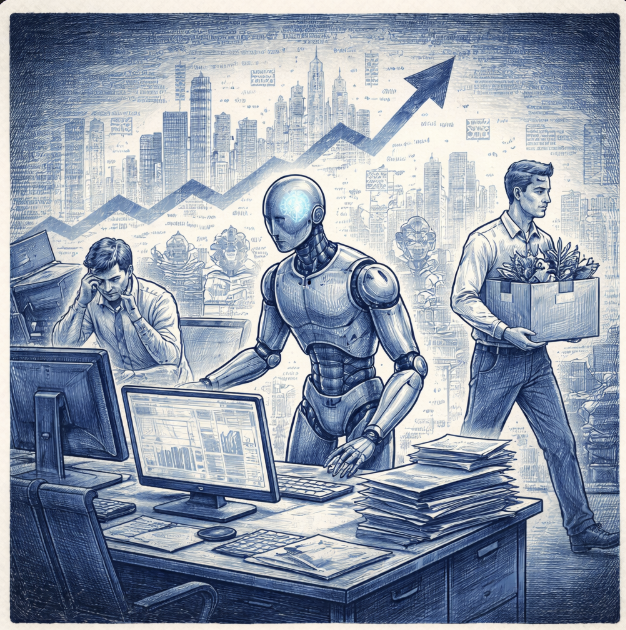 Automation rises as office uncertainty grows Automation rises as office uncertainty grows
Good Morning, AI is starting to move from "demo" to "day-to-day," and markets are watching what that means for profits and jobs. New chatter says companies are entering an AI "harvest phase," where the payoff shows up in faster work and lower costs, but investors are also pricing in a risk that white collar roles get squeezed next. We break down what's driving that split message, why it matters for big tech and the broader market, and the signals to track in earnings and hiring.
A TSA funding lapse threatens airport delays, Kraft Heinz doubles down on a $600M internal turnaround instead of splitting up, and surging coffee prices push consumers toward home brewing, pressuring café chains.
Don't forget to voice your opinion in my polls below.
Here are your Morning Bullets. – Truly yours, Fred Frost |
📉 Yesterday's Market RecapYesterday's market painted a mixed picture as investors digested cooling inflation data and braced for policy shifts. The S&P 500 eked out a modest gain, while tech and steel sectors saw volatility amid tariff uncertainty and AI disruption fears. Let's break down the movers.
- Inflation Dips to 2.4% in January: The latest CPI report showed annual inflation slowing to 2.4%, below expectations, fueling hopes for Fed rate cuts by June. → CNBC
- Steel Stocks Slide on Tariff Rollback Rumors: Cleveland-Cliffs (CLF) dropped over 20% in five days as reports surfaced of potential tariff reductions by the Trump administration. → Stocktwits
- Tech Earnings Drive After-Hours Swings: Applied Materials surged 11% post-earnings, while DraftKings tanked 15% on weak 2026 guidance, reflecting uneven sector strength. → CNBC
|
📉 Daily Performance Snapshot| Index/Asset | Closing Value | Change |
|---|
| S&P 500 | 6,836.17 | +3.42 (+0.05%) | | Nasdaq | 22,546.67 | -49.71 (-0.22%) | | Dow Jones | 49,500.93 | +49.45 (+0.10%) | | Gold | $5,042.74 | +0.29 (+0.01%) | | Crude Oil | $62.89 | +0.05 (+0.08%) | | Bitcoin | $68,960.00 | -696.00 (-1.00%) | | 10-yr Treasury Yield | 4.056% | -0.048 (-1.17%) |
|
🔭 What to Watch TodayToday's calendar brings earnings reports and geopolitical developments that could ripple through markets. Keep your eyes on these key events as they unfold. Sonoco Products Q4 Earnings (After Close): Analysts expect a 29.4% revenue jump to $1.76B despite a 14.5% EPS drop. A key gauge for industrial sector health. → Seeking AlphaU.S.-Iran Nuclear Talks in Geneva: High-level discussions could shift oil market dynamics if sanctions relief is tied to nuclear concessions. → BenzingaArmada Hoffler Properties Q4 Results (After Close): Revenue projected to fall 51.9% to $68.62M. Real estate investors will watch for signs of market stabilization. → Seeking Alpha |
💡 Opportunity WatchAmid market turbulence, a few bright spots emerge for those willing to look beyond the headlines. Here are three areas where recent events could spell upside for sharp investors. - Gold Futures (GC=F): With prices hitting $4,990.01 per ounce, gold's 65% gain in 2025 positions it as a hedge against inflation and market volatility. → Money.com
- Reddit (RDDT): Insider buying of $7.5M by Director Sarah Farrell post-earnings signals confidence in the stock despite market skepticism. → TheStreet
- Waystar Holding Corp. (WAY): Baron Discovery Fund's new stake highlights strong growth potential in healthcare revenue management with 45% EBITDA margins. → Seeking Alpha Articles
|
Sponsored Content Hedge Funds Are Rotating to Hardware While retail traders chase hype, smart money is moving into the hardware layer powering AI itself. Our research highlights three U.S. companies leading this quiet surge: one with 76% data-center growth, another with a massive backlog from global hyperscalers, and a third supplying next-gen chips with 59% margins. When everyone else notices, the easy gains will be gone. View the Premium Research Report By clicking this link you agree to receive emails from StockEarnings and our affiliates. You can opt out at any time. Privacy Policy. |
🔥 The Big BulletAI's "harvest phase" collides with rising job-loss fearsWhat happened: A long-time AI researcher said AI is moving from testing to real, everyday use, with benefits showing up faster in 2025. In that view, companies are shifting into a "harvest phase," where they start getting bigger gains from tools they already built. The same idea shows up in business results as firms automate routine tasks and speed up office work. At the same time, some investors are focused on a darker risk: that AI could cut many white-collar jobs. A new market narrative argues that stock prices may be reacting to worries about how fast that job shift could happen. Together, these stories point to a split message: more output for companies, but more uncertainty for workers. The debate is being shaped by recent commentary such as AI moving into a "harvest phase" after productivity gains doubled in 2025 and coverage suggesting markets are pricing in fears of an AI-driven white-collar shakeup.
Why it matters: If AI really boosts output, it can lift profits without needing as many new hires. That can help big tech and software firms, but it can also change how investors value "growth" versus "defense." When job fears rise, consumers may spend less, which can hurt retail and services even if tech looks strong. Market tone can shift quickly when traders watch megacap names and index futures, like in a futures-focused look at Apple, Google, Amazon, and Nvidia in a tricky tape. Investors may also chase "AI winners," which can push some stocks up fast and raise the risk of sharp pullbacks. That dynamic shows up in hype-driven ideas like a pitch that an AI stock could reward early buyers by the end of 2026. For conservative investors, the key point is that faster AI adoption can widen the gap between leaders and laggards. It can also increase volatility as people argue over whether the bigger effect is higher productivity or job disruption. What's next: Watch for hard evidence in company reports: are costs falling because of AI, or are sales rising because service is better? Pay attention to hiring plans, since headcount choices may show where AI is replacing work versus supporting it. In the near term, more firms may try to calm fears by saying AI helps workers instead of removing them. Industry groups are also stressing limits, like the idea that AI struggles with deep company-specific knowledge. That view is reflected in comments such as "AI can't copy deep enterprise context," according to a Nasscom leader. Another angle to track is how IT services firms adapt, including debate on whether AI helps or hurts traditional IT services work. For markets, the next catalyst is often guidance: what executives say about 2026 budgets for software, chips, and cloud. If layoffs rise while profits climb, the political and policy pressure around AI could increase quickly. |
| | Reader Feedback | Last time, I asked you: When a government pushes companies to use AI, what do you think happens next? | The majority of you at 50% said "It puts jobs at risk" | Brianna from West Virginia replied: "I think it puts jobs at risk because companies might replace workers with A.I." | Here's what I'm asking you today:Which do you think is more likely to happen next? | |
|
| As always if your opinion is not here, or you want to throw your two cents at me, reply to the E-mail, and let me know your exact thoughts. |
🧭 Policy & Market Ripples- TSA Shutdown Woes Threaten Travel: A DHS funding lapse leaves TSA staff unpaid, risking delays at airports as absenteeism looms—travel stocks could feel the pinch. → Benzinga
- Kraft Heinz Shelves Split, Bets on $600M Turnaround: CEO Cahillane halts the company breakup, redirecting focus to internal fixes with a $600M investment in R&D and marketing. → Fox Business
- Coffee Price Surge Alters Consumer Habits: With U.S. coffee prices up 18.3% year-over-year, consumers pivot to home brewing, impacting cafe chains like Starbucks. → Fortune
|
📜 This Day in History – February 16 February 16 is an exercise in institutional upgrades — from museums shaping public knowledge, to transportation linking continents, to copyrights defining creative markets, to satellites extending the reach of global communication. |
| Today's TriviaWhich of the following is an example of a variable expense? | |
|
| 82% of you chose the right answer to our previous trivia question: Which situation best demonstrates opportunity cost? |
People say that money is not the key to happiness, but I figured if you have enough money, you can have a key made.
– Joan Rivers | Thanks for Reading.
Stay Sharp. Stay Focused.
Fredrick Frost
Editor, MorningBullets |
|
|
|





No comments:
Post a Comment