You're reading The Morning Dispatch, our flagship daily newsletter explaining all the news you need to know today in fewer than 15 minutes. To unlock the full version, become a Dispatch member today. | | We're hitting the road and heading to Dallas, Texas, for Dispatch Energy: The Current State, a symposium focused on the future of energy innovation. You can catch Jonah Goldberg, Steve Hayes, and more of your favorite Dispatch authors as we bring our Dispatch Energy newsletter to life. Tickets are available here—but hurry, they're almost sold out. | | Happy Friday! We hope you all have a lovely weekend, and if you want some more Dispatch content in your life, the team at SCOTUSblog will be live blogging the Supreme Court's possible announcement of opinions today, starting at 9:30 a.m. EST. | Quick Hits: Today's Top Stories |  | The Board of Peace Meets in Washington |
| President Donald Trump hosted world leaders in Washington, D.C., on Thursday for the first meeting of the Board of Peace, an international panel chaired by Trump, established to oversee the reconstruction of Gaza and other potential projects worldwide. Trump said that nine member nations contributed a combined $7 billion toward a Gaza reconstruction fund, and that the U.S. would contribute $10 billion, but he did not identify a source of that funding. Trump said he hoped not to use military force against Hamas and that the terrorist group would voluntarily disarm, and that it "looks like they're going to be doing that, but we'll have to find out." Five countries—Albania, Indonesia, Kazakhstan, Kosovo, and Morocco— pledged to deploy a peacekeeping force to Gaza as part of the reconstruction project. Egypt and Jordan also committed to helping train new Gaza police officers. Nickolay Mladenov—a former United Nations envoy and Bulgarian foreign affairs minister who serves as the board's high representative for Gaza—said that NCAG had already received 2,000 applications. To learn more about the Board of Peace, read the January 23 issue of TMD. | - The Board of Peace's Gaza administrative panel, the National Committee for the Administration of Gaza (NCAG), announced that its application process "is open to qualified men and women who wish to serve in the police force" for Gaza.
- The soccer organization FIFA also pledged $50 million toward building a soccer stadium in Gaza, plus $15 million to build a FIFA academy there.
- Belarusian Foreign Minister Maxim Ryzhenkov had planned to attend the meeting, but the U.S. government did not issue the necessary visas for his delegation, according to his office.
|  | Trump Mulls Action Against Iran |
| While speaking at the Board of Peace meeting, Trump said that he will decide whether to take military action against Iran "over the next probably 10 days." CBS News reported that U.S. forces would be ready to strike as soon as this weekend, but the president had not yet committed to it. "Maybe" Iran will accept a deal on favorable terms, he said. "Otherwise, bad things happen." In an interview with French media, International Atomic Energy Agency (IAEA) Director General Rafael Grossi described his meeting in Geneva with Iranian officials earlier this week as "two steps forward," but that much work remained. "We don't have much time," Grossi warned, noting that Iran's stockpile of highly enriched uranium "is still there" and "remains" despite U.S. airstrikes on Iranian nuclear facilities last June. Iran's atomic energy chief Mohammad Eslami claimed that the country was operating within IAEA guidelines, while also reaffirming Iran's right to "peacefully benefit" from the enrichment of uranium. | - The Iranian government told U.N. Secretary-General António Guterres the country was prepared to take "decisive" action in the event of an attack and that possible targets include all bases, facilities, and assets in the Middle East operated by the "hostile force."
- The BBC reported that the U.K. has not granted the U.S. permission to use British military bases as potential launch sites for a military operation against Iran.
|  | Little Hope for Russia-Ukraine Peace Deal |
| European intelligence officials told Reuters yesterday that they see a Ukraine-Russia peace deal as unlikely this year, with four of the five individuals telling the outlet that they believe the Kremlin is using the talks to secure U.S. sanctions relief and business opportunities. According to Reuters calculations, Russia's government brought in $5.35 billion in oil and gas revenue in February, nearly half of its revenue in February 2025. Meanwhile, the International Monetary Fund (IMF) said on Thursday that it would review a staff-level agreement to provide an $8.1 billion lending program to Ukraine, after an IMF spokeswoman said that Ukraine had completed the necessary prerequisites, including adopting a new budget and drafting labor measures. | - Russian forces launched drones and missiles to attack four Ukrainian areas on Thursday, injuring at least nine civilians. Meanwhile, Russian officials said that Ukrainian drones struck the Crimean port city of Sevastopol, which Russia has occupied since 2014, killing one person.
- Sweden announced a new defense aid package for Ukraine worth more than $1.4 billion, which includes air defense systems, long-range missiles, and ammunition.
- Ukrainian and Moldovan authorities launched a joint investigation into an alleged plot to assassinate several "public figures" in Ukraine, which they claimed Russian intelligence services were behind.
|  | Venezuela Passes Amnesty Bill |
| Venezuela's legislature on Thursday passed a limited amnesty bill, immediately signed into law by acting Venezuelan President Delcy Rodríguez, that will free political prisoners detained by the Venezuelan regime under former leaders Hugo Chávez and Nicolás Maduro. The proposal would grant amnesty for those punished for participating in certain anti-government protests—in a push to "repair deep wounds," according to the bill's text—but excludes those arrested for "military rebellion" during 2019 anti-regime protests. Prisoners whom the government said were detained for taking part in serious violent offenses will not be granted amnesty under the bill, but several human rights groups warn that the Venezuelan regime has often accused political prisoners of violence while supplying little to no supporting evidence. | - Human rights groups claim that more than 600 people remain detained on political grounds, while 448 prisoners have been released since early January.
- The bill also provides no restitutive justice to those released, including the return of money or other assets seized by the government, or the reversal of bans that prevent them from holding public office.
|  | New York Redistricting Map Goes to Supreme Court |
| Two separate groups of New York voters and Democratic public officials on Thursday requested that the Supreme Court not interfere with a prior state court ruling ordering New York to redraw its congressional map before the 2026 midterm elections. State Republicans asked the Supreme Court last week to issue an emergency stay to keep the current maps for the midterms, but voters and officials on Thursday argued that the justices lacked the authority to hear the matter. Specifically, last month, New York Supreme Court Justice Jeffrey Pearlman ruled that New York's 11th Congressional District, the only Republican-held seat representing New York City, diluted the voting power of black and Latino residents, and ordered the state to redraw maps that better represented them. To learn more about the arguments, read Amy Howe's piece in SCOTUSblog. | - On Thursday, a five-judge panel in New York's Appellate Division unanimously ruled that the state must redraw the congressional map, dealing another blow to Republicans' effort to preserve the current boundaries.
- New York voters and Republican officials, including GOP Rep. Nicole Malliotakis—who currently represents New York's 11th Congressional District—requested that the Supreme Court intervene and block Pearlman's ruling, arguing that the order violated the 14th Amendment's Equal Protection Clause.
- They also argued that a new map with boundaries that complied with Pearlman's order would itself constitute a racially motivated gerrymander.
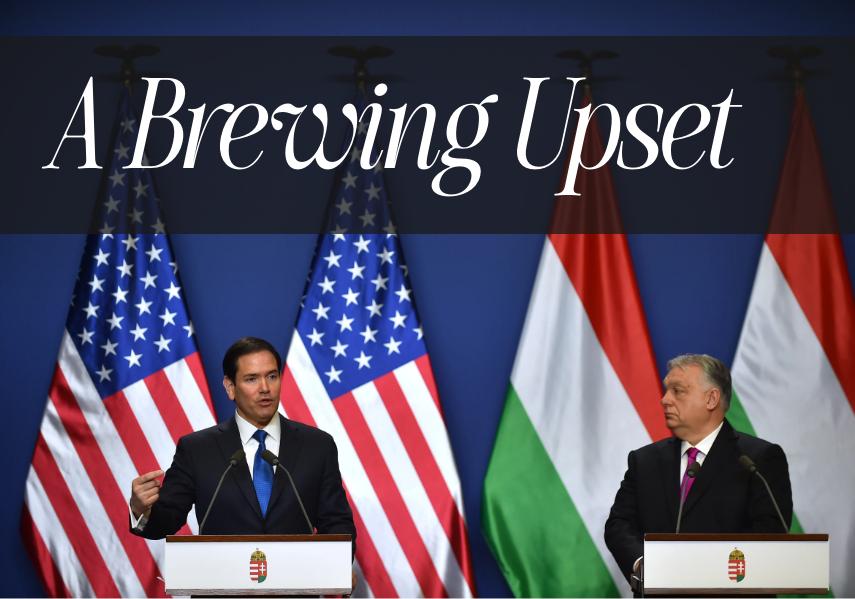
| | | U.S. Secretary of State Marco Rubio and Hungarian Prime Minister Viktor Orbán. (Photo by Balint Szentgallay/NurPhoto via Getty Images) | Over the past year, through speeches at halls packed with irate European diplomats, inflammatory social media posts, and official U.S. strategy documents, the White House has declared it will begin taking sides in European politics. The Trump administration warns that many of the continent's political parties are risking "civilizational erasure," and has promised to support "patriotic" movements and leaders. Last week, after speaking at the Munich Security Conference, Secretary of State Marco Rubio issued a near-endorsement for the administration's favorite European nationalist: Viktor Orbán, the prime minister of Hungary, whose Fidesz party has ruled the country for the past decade and a half. "Especially as long as you're the prime minister and the leader of this country, it's in our national interest that Hungary be successful," he told Orbán during a visit to Hungary announcing a deal on nuclear power. "Your success is our success," Rubio said, while promising a "golden age" in relations between the U.S. and the central European nation of about 9.5 million people. The kudos were well-timed for Orbán, who is facing a tough reelection challenge in April from the charismatic conservative Péter Magyar and his center-right Tisza party. Multiple polls have shown Tisza leading ahead of the April 12 parliamentary elections, although others show Fidesz in the lead. But why does the White House—not known for flattering European politicians in recent years—care so much about a parliamentary election in one of Europe's worst-performing countries? And will the results of the April 12 election mark a defeat for one of Europe's most prominent exemplars of conservative populism? | | You are receiving the free, truncated version of The Morning Dispatch. To read the full newsletter—and unlock all of our stories, podcasts, community benefits, and our newest feature, Dispatch Voiced, which allows you to listen to our written stories in your own podcast feed—join The Dispatch as a paying member. | | | | | | Thomas Sheppard | Hashed out over the first four decades of the 20th century—particularly during the interwar years—War Plan Orange established how the United States would fight Japan should the two nations ever come to conflict. Come World War II, the plan would form the pillar of the American Navy's victory in the Pacific. Thomas Sheppard, who teaches War Studies at the Marine Corps University Command and Staff College, writes on this oft-forgotten war plan. While most Americans remember the Navy's failure to anticipate the attack on Pearl Harbor, Sheppard writes that two decades of "ultimately successful thinking preceded that fateful day. From a morass of interservice bickering, flawed assumptions, and hopeless expectations emerged the force that would destroy the Japanese Empire." | | | |  | A Footnote on Jesse Jackson | Kevin D. Williamson | The civil rights icon was haunted by two ghosts: one of his mentor, and one of the man he could have been. |
|
| | | | | | Today in America | - The Advisory Committee on Immunization Practices, which issued recommendations to the Centers for Disease Control and Prevention on vaccine use, announced it will postpone its meeting this month, initially scheduled for February 25-27.
- Shawn DeRemer, the husband of Labor Secretary Lori Chavez-DeRemer, has reportedly been barred from entering the agency's headquarters after at least two female employees accused him of sexual assault.
- Democratic Mayor Muriel Bowser of Washington, D.C., wrote a letter to Trump requesting that the Federal Emergency Management Agency pay for all "costs incurred" by a massive sewage spill in the Potomac River.
- The White House announced a new trade deal with Indonesia, which would see the removal of 99 percent of tariffs on American goods and a 19 percent tariff on Indonesian imports. There will also be tariff exemptions for Indonesian chocolate, natural rubber, and coffee, the Indonesian government announced.
- Authorities in Cameroon arrested one lawyer and four reporters, including three journalists on assignment for the Associated Press, who were filming a detention center holding deportees from the U.S.
- Norway continues to lead the overall Olympic medal count with 34, and the gold medal count with 16. The U.S. has won 27 medals at the Winter Olympics: nine gold, 12 silver, and six bronze.
| Around the World | - A new report from the United Nations Independent International Fact-Finding Mission for the Sudan found that the paramilitary Rapid Support Forces (RSF)'s 18-month-long siege on the Sudanese city of Al Fashir had "hallmarks of genocide." The U.S. announced new sanctions on the RSF later that day.
- Poland withdrew from an international convention banning the use of antipersonnel mines and said it will use them—along with anti-tank land mines—to defend its eastern borders with Russia and Belarus
- Former British Prince Andrew Mountbatten-Windsor was released from police custody after being questioned about potential misconduct related to Jeffrey Epstein in authorities' ongoing investigation.
- Peru's Congress elected 83-year-old left-wing lawmaker José Balcázar the interim president until July, when power will transition to the winner of the country's April elections, or a possible June runoff race.
- A Tunisian court sentenced Ahmed Saidani, a lawmaker arrested for mocking President Kais Saied in social media posts, to eight months in prison.
| On the Money | - Los Angeles County became the latest district to sue the online gaming platform Roblox for allegations it failed to protect its minor users from sexual exploitation and abuse.
- The U.S. Equal Employment Opportunity Commission announced on Wednesday that it filed a lawsuit against Coca-Cola Beverages Northeast, a regional distributor and bottler partnered with the Coca-Cola corporation, alleging that the company violated anti-discrimination law by hosting an employer-sponsored trip available only for female employees.
- In December, the U.S. imported more from Taiwan than China for the first time in decades. Imports from China fell 44 percent compared to the previous December, whereas Taiwanese imports more than doubled.
- Amazon brought in $717 billion in sales in 2025, surpassing Walmart as the global sales leader, which recorded $713 billion last year.
- Walgreens is laying off more than 600 employees in Illinois, where the company is headquartered, and in Texas, where it is closing a distribution center.
| Worth Your Time | | Presented Without Comment | New Zimbabwe: Late Former President Mugabe's Son Chatunga Arrested in Johannesburg After Shooting Employee | Also Presented Without Comment | Kent Online: 'I Couldn't Believe My Eyes': Parking Warden Slaps Ticket on Bus at Bus Stop in Tenterden | Also Also Presented Without Comment | Revolver: William Shatner Teams With Zakk Wylde, Henry Rollins and More for Upcoming Metal Album | | Have any thoughts or questions about today's newsletter? Become a member to unlock commenting privileges and access to a members-only email address. We read every submission, and answer questions in the following edition of TMD. | | | | Sent to: lepobook@gmail.comYou received this email because you signed up for The Dispatch. To stop receiving this type of email, unsubscribe here. Opt out from all emails here. © 2026 The Dispatch, PO Box 33337, Washington, DC 20033, United States |
|





No comments:
Post a Comment