Any content you receive is for information purposes only. Always conduct your own research. *Sponsored
ENvue Medical, Inc. (NASDAQ: FEED) Just Hit The Top Of Our Watchlist This Morning—Thursday, July 9, 2026
Don’t Miss Our Next Update—Get Real-Time Alerts Sent Directly To Your Phone. Up To 10X Faster Than Email. Get FEED Up On The Screen While It’s Still Early…
July 9, 2026 Dear Reader, Sometimes the biggest developments don't arrive all at once. They begin connecting one after another until the broader story starts coming into focus. That's exactly what has happened over the past several weeks, and it's one of the reasons this company has climbed near the top of our watchlist. And that is exactly why ENvue Medical, Inc. (NASDAQ: FEED) just landed on our radar this morning—Thursday, July 9, 2026. 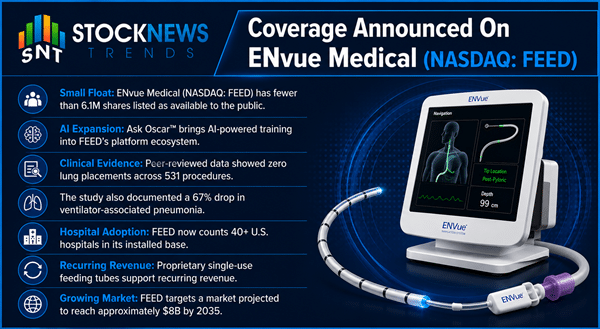
But keep in mind, FEED has less than 6.1M shares listed as available to the public right now. When companies have small floats like this, the potential exists for big moves if demand begins to shift. FEED appears to be flying under the radar as it’s currently trending in the $.50 - $.60 range and was well above the $1 mark less than two months ago, according to data available from Barchart. That setup alone would be enough to get our attention, but the recent news flow is where the story starts to become even more interesting. On June 9, 2026, ENvue Medical, Inc. introduced "Ask Oscar™," an AI-powered training platform designed to lower one of the most persistent barriers in medical device adoption: clinician training. The platform builds on the company's existing electromagnetic navigation infrastructure, enabling nurses and dietitians to train independently—without requiring on-site specialists—and is expected to be commercially available within coming months, opening a new recurring revenue stream across ENvue's growing hospital customer base. The timing was not accidental. Just days earlier, on June 3, an independent peer-reviewed study published in Critical Care Nurse documented what ENvue's technology accomplished across 531 consecutive feeding tube placements at Inova Health System: zero lung placements across 531 consecutive placements, a 67% reduction in ventilator-associated pneumonia, a dramatic increase in bedside post-pyloric feeding access that previously required interventional radiology, more than 350 nursing hours recovered annually, and over $1.5M in annual cost avoidance. Numbers like those, independently verified and published in a peer-reviewed journal, represent the kind of clinical validation that institutional buyers require before standardizing a technology. Against that clinical backdrop, ENvue now counts 40+ U.S. hospitals in its installed base, a secured three-year purchasing agreement renewal with a GPO representing one of the largest health systems in the country operating over 90 hospitals, and a commercial pipeline that management has described as actively converting. The company's revenue model is platform-based and designed for compounding growth. Each ENvue Navigation System placed in a hospital requires proprietary single-use consumable feeding tubes unique to the platform, meaning every procedure performed on the installed hardware drives downstream recurring revenue. As the hospital footprint scales, that consumable layer grows with it—without proportional increases in customer acquisition cost. For a company at ENvue's current stage of commercial development, that dynamic is worth understanding. What is emerging here is a medtech story centered on replacing an 85-year-old clinical standard. According to ENvue's own market analysis, more than 13M nasoenteral feeding tube placements occur in U.S. hospitals each year, and 85% are performed blindly—without any real-time visual guidance. 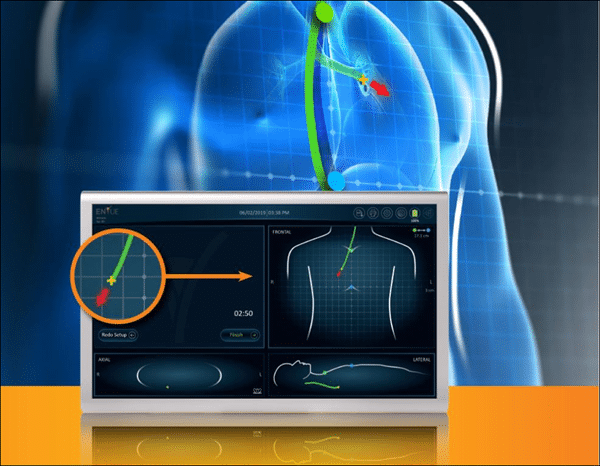
The ENvue Navigation Platform addresses that gap directly, providing continuous electromagnetic visualization of tube position throughout the procedure, reducing reliance on post-placement X-ray confirmation and the associated radiology bottlenecks, staffing pressures, and complication risk that hospitals are under increasing pressure to eliminate. About ENvue Medical, Inc. (NASDAQ: FEED)
FEED is a commercial-stage medical device company headquartered in Tyler, Texas, with research and development operations in Tel-Aviv and Nesher, Israel, and commercial operations in Arlington Heights, Illinois. The company was formerly known as NanoVibronix, Inc., rebranding in December 2025 following the acquisition of ENvue Medical Holdings to reflect its primary strategic focus on the ENvue Navigation Platform. ENvue operates two distinct technology platforms. The ENvue Navigation Platform is a minimally invasive electromagnetic navigation system cleared by the FDA under 510(k) for adult use, providing real-time bedside visualization of tube movement through three simultaneous views with automated alerts when a feeding tube approaches the airway. The second platform comprises acoustic-based therapeutic devices—PainShield®, a patch-based therapeutic ultrasound device for pain management and joint contractures, and UroShield®, designed to reduce bacterial colonization and biofilm in urinary catheters. UroShield was recently added to the UK National Health Service Drug Tariff Part IX, enabling nationwide prescription reimbursement in the UK. Revenue is generated through a platform model. Hospitals acquire the ENvue Navigation System and subsequently consume single-use proprietary feeding tubes on a per-procedure basis, creating predictable, recurring revenue tied directly to clinical utilization. In January 2026, ENvue expanded beyond the acute care setting with the launch of its ENFit Syringe line for over-the-counter distribution through a strategic partnership with U-Deliver, extending the ENvue brand into home care and non-acute settings. A $8B Market Is Quietly Replacing an 85-Year-Old
Clinical Standard
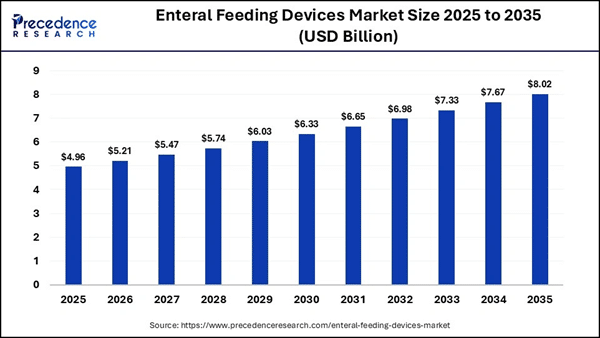
ENvue Medical operates within the global enteral feeding devices market, a sector undergoing structurally supported expansion. According to Precedence Research, the global enteral feeding devices market was valued at $4.96B in 2025 and is projected to reach $8.02B by 2035, representing a compound annual growth rate of 4.92% over the forecast period. In the United States specifically, the market is expected to grow from $1.32B in 2025 to $2.15B by 2035. The growth thesis is straightforward: chronic disease prevalence is rising, surgical volumes are increasing, and hospitals face compounding pressure to reduce complications, staffing burden, and imaging costs. North America holds the largest share of the global market, driven by an aging population, elevated healthcare expenditure, and increasing investment in intelligent tube placement technology. The hospital segment commands the dominant end-user share—which is precisely the primary sales channel ENvue is targeting. Precedence Research specifically highlights that innovative companies developing app-connected pumps and advanced tube placement systems are attracting venture capital and accelerating commercialization—a direct validation of the product category FEED is building ENvue is not attempting to displace an established category leader; it is working to replace a legacy clinical practice with a modernized, real-time guidance standard that hospitals are under growing regulatory and operational pressure to adopt. The First Half of 2026 Was Busy for ENvue. Here's What You Need to Know.
A lot has happened for ENvue Medical in the first half of 2026. Here are the developments that matter most. The clinical data is now on record. In June, an independent study published in Critical Care Nurse documented what the ENvue Navigation Platform delivered across 531 consecutive feeding tube placements at Inova Health System: zero tubes placed in the lungs, a 67% drop in ventilator-associated pneumonia, a dramatic increase in bedside post-pyloric feeding access that previously required interventional radiology, and over $1.5M in annual cost savings per health system. That is peer-reviewed, independently verified clinical evidence—the kind hospitals require before committing to a new standard of care. AI has entered the platform. Also in June, ENvue launched Ask Oscar™, an AI-powered training tool that allows nurses and dietitians to learn the system independently—without needing an on-site specialist. It also lays the groundwork for ENvue Drive, the company's robotic-assisted feeding tube navigation system currently in development. 
Existing hospital relationships are expanding. In June, ENvue deployed into the burn ICU of a major U.S. academic health network—a second unit within the same hospital system. When a hospital that already uses the platform begins adopting it in additional departments, that is a strong sign the technology is working and clinicians trust it. Long-term contracts are being signed. In May, ENvue locked in a three-year purchasing agreement renewal with a GPO that serves one of the largest health systems in the country—over 90 hospitals. Shortly after, a separate 12-hospital network in Virginia and North Carolina renewed for three years and formally designated the ENvue Navigation Platform as its standard of care for bedside feeding tube placement through 2028. The patent portfolio is growing. The USPTO granted ENvue a Notice of Allowance in February 2026 for a next-generation feeding tube that combines electromagnetic navigation with a built-in camera—giving clinicians both real-time positioning and direct internal visualization in a single device. A second Notice of Allowance followed in May covering ultrasound-enhanced dr-ug delivery technology, adding another layer to the company's IP position. 7 Reasons Why FEED is Topping Our Watchlist This Morning—Thursday, July 9, 2026…
1. Small Float: With fewer than 6.1M shares listed as available to the public, FEED’s small float could witness the potential for big moves if demand begins to shift. 2. AI Expansion: FEED recently introduced Ask Oscar™, an AI-powered training platform designed to help clinicians learn the ENvue Navigation System independently while supporting the company's platform ecosystem. 3. Clinical Evidence: FEED is backed by an independent peer-reviewed study documenting zero lung placements across 531 consecutive procedures, a 67% reduction in ventilator-associated pneumonia, and more than $1.5M in annual cost avoidance within the health system studied. 4. Hospital Adoption: FEED now has 40+ U.S. hospitals using its platform, along with recent multi-year purchasing agreement renewals and expanding deployments within existing health systems. 5. Recurring Revenue: FEED's platform pairs installed navigation systems with proprietary single-use feeding tubes, creating recurring revenue tied to ongoing clinical utilization. 6. Modernizing Care: FEED is developing technology aimed at replacing an 85-year-old bedside feeding tube placement approach with real-time electromagnetic navigation that provides continuous visualization during placement. 7. Growing Market: FEED operates in an enteral feeding devices market that Precedence Research projects will expand from approximately $4.96B in 2025 to $8.02B by 2035, supported by increasing demand for advanced tube placement technologies. Get FEED Up On The Screen While It’s Still Early…
Several important pieces are now beginning to come together for FEED. A relatively small float, expanding hospital adoption, an AI-powered training platform, independently published clinical evidence, a platform designed to generate recurring revenue through ongoing clinical use, and a technology focused on modernizing an 85-year-old clinical practice all contribute to why this company has climbed onto our watchlist. Add in a healthcare market projected to continue expanding over the coming years, and it's easy to understand why FEED is a company we'll be following closely. We have all eyes on FEED this morning. Take a look at FEED while it’s still early. Sincerely, Jeff Ackerman
Managing Editor
Stock News Trends |


No comments:
Post a Comment