Any content you receive is for information purposes only. Always conduct your own research.
*Sponsored
Heading Into Tuesday, Astrotech Corporation (Nasdaq: ASTC) Tops Jeff Ackerman's Watchlist—August 11, 2026
Don’t Miss Our Next Update—Get Real-Time Alerts Sent Directly To Your Phone. Up To 10X Faster Than Email. Pull Up ASTC While It’s Still Early… August 11, 2026 Dear Reader, Good morning. The bell rings in less than 90 minutes. Last night we put Astrotech Corporation (Nasdaq: ASTC) on the desk. The setup hasn't changed — and the open is getting close. If you haven't had a chance to read the full report yet, now is the time. Pull it up before the bell. 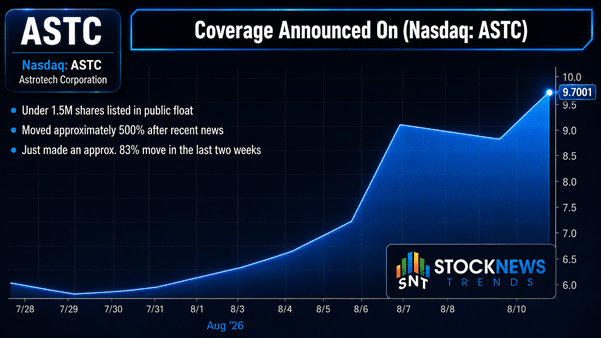
But keep in mind, ASTC has less than 1.5M shares listed as available to the public right now. When companies have small floats like this, the potential exists for big moves if demand begins to shift. And here’s why we have our focus on ASTC this morning. Recently, ASTC’s board formally approved a strategic lunar resource initiative targeting silicon-28 and helium-3 — the two materials at the center of the quantum computing supply chain bottleneck. Silicon-28 is required for spin-qubit processors. Helium-3 is required to cool quantum systems to operating temperatures. Neither has an adequate domestic U.S. supply chain. The Moon has both. That announcement sent ASTC up more than 500% (approx.) in a single session and reportedly over (approx.) 1,100% for the week. And in the last two weeks alone, ASTC has made an approximate 80% move, from around $6 on July 29 to $11.01 on Monday, August 10. The quantum computing market was valued at approximately $5.59B in 2026 and is projected to reach $25.63B by 2032 — and the materials problem is what stands between today's lab-scale systems and that scale-up. Then on June 30, Astrotech submitted a formal proposal to NASA's Commercial Lunar Payload Services 2 program seeking approximately $20M in Phase 1 non-dilutive funding — from a program with a total reported contract ceiling of up to $10B. That's a federal agency putting a number on what lunar payload delivery is worth over the life of the program, and Astrotech is formally in the queue. Before that, the company had built what it describes as the only field-deployed mass spectrometry ETD certified in global aviation security operations — a regulatory stack that includes TSA Air Cargo approval, ECAC G1 certification, a separately granted ECAC wand-swabbing certification, a DHS development contract, and active entry into the TSA checkpoint certification process. The board then approved a potential sale of that asset — framing the timing around a valuation peak ahead of the anticipated next-generation federal ETD procurement cycle, with proceeds earmarked for the lunar initiative. That's a deliberate sequencing of events, not a coincidence. Here is what has us watching ASTC heading into Tuesday, August 11, 2026. About Astrotech Corporation
Astrotech Corporation (Nasdaq: ASTC) is a science and technology company headquartered in Austin, Texas. Born from NASA and SpaceHab Inc., Astrotech brings space-grade science and engineering to real-world applications — a lineage stretching back to 1984. In February 2009, the company changed its name from SPACEHAB, Incorporated to Astrotech Corporation to better reflect its heritage in pre-launch processing facilities and services — a business that had supported the processing of more than 280 spacecraft without impacting a customer's launch schedule. Today, Astrotech creates, operates, and scales technology businesses through a portfolio of wholly owned subsidiaries — each built around its core mass spectrometry and gas chromatography platform. The lineup spans field-portable environmental analysis via the Labrador HH-GC, biomass essential oil process control, and autonomous GC-MS systems designed for both industrial and extraterrestrial environments. That last point is not incidental — Pro-Control's process control technology was purpose-built to operate on the lunar surface. The board has approved a potential sale of one of its subsidiaries to generate capital for the company's lunar initiative. If completed, that transaction would redirect proceeds toward the lunar strategy and transform ASTC's financial profile and operational focus simultaneously — positioning the company as a more concentrated play on what it is now building in space. Where Quantum Computing's Biggest Bottleneck Actually Lives

Two distinct and structurally undersupplied markets sit at the center of what Astrotech is positioning around. The first is the quantum computing supply chain. The quantum computing market was valued at approximately $5.59B in 2026 and is projected to reach $25.63B by 2032 at a CAGR near 29%. The hardware bottleneck that most observers flag as the primary constraint on that growth rate isn’t chips or software — it’s materials. Silicon-28 has no established domestic U.S. supply chain. Helium-3, required to cool quantum systems to near absolute zero, is produced almost exclusively as a byproduct of tritium decay in nuclear weapons stockpiles. The structural annual deficit between terrestrial helium-3 supply and quantum computing demand is estimated at 20,000 to 40,000 liters per year — and it is widening. The second is commercial lunar access. NASA’s CLPS program has already funded multiple missions to the lunar surface. CLPS2 extends that framework with a larger budget ceiling and a broader technology mandate. For companies with documented spaceflight heritage — actual missions, actual processing campaigns — the competitive positioning in a CLPS2 award process is materially different from companies without that track record. Astrotech’s Pro-Control subsidiary produces autonomous process control systems designed expressly for both terrestrial industrial and lunar surface environments. From EU Aviation Certification to a NASA Proposal
— Here's the Timeline
May 11, 2026 — The TRACER 1000 received ECAC/EU G1 certification — the highest European standard for aviation security trace detection — covering passenger and cargo screening. The system was already deployed in 16 countries. May 21, 2026 — EN-SCAN, Inc. commercially launched the Labrador HH-GC, a ruggedized portable gas chromatograph delivering laboratory-grade VOC analysis across air, water, and soil in approximately three minutes on-site. May 27, 2026 — The board approved a strategic lunar resource initiative targeting silicon-28, helium-3, water ice, and platinum group metals. CEO Tom Pickens stated the company "believes the Moon may offer unique long-term value from regolith mining, quantum computing solutions, and autonomous manufacturing infrastructure." ASTC surged more than 500% in that session. June 8, 2026 — The TRACER 1000 received a second ECAC certification for wand-swabbing operations, extending approved use to no-touch passenger and cargo screening at EU airports. June 16, 2026 — The board approved a potential sale process for the company's trace detection subsidiary, describing the TRACER 1000 as the only field-deployed mass spectrometry ETD certified in global aviation security. Proceeds designated for the lunar initiative. June 30, 2026 — Astrotech submitted a Phase 1 proposal to NASA's CLPS2 program seeking approximately $20M in non-dilutive funding. On the same day, the company filed a $200M mixed securities shelf registration with the SEC. July 22, 2026 — Astrotech expanded its board from five to six directors, appointing Matt Kreps — a capital markets and IR veteran — as the newest board member. 7 Reasons Why ASTC Is Topping Our Watchlist This Morning— Tuesday, August 11, 2026… 1. Ultra-Low Float: with fewer than 1.5M shares listed as available to the public, ASTC’s small float could witness the potential for big swings if demand begins to shift. 2. Big Moves On The Chart: following its May 27 lunar initiative announcement, ASTC moved more than approximately 500% during that session and was reportedly up approximately 1,100% for the week. 3. NASA Proposal: after submitting a Phase 1 proposal seeking approximately $20M in non-dilutive funding, ASTC now has a formal submission tied to NASA’s CLPS2 program, which carries a reported ceiling of up to $10B. 4. Lunar Initiative: with its board approving a strategy targeting silicon-28, helium-3, water ice, and platinum group metals, ASTC has placed lunar resources and infrastructure at the center of its developing space strategy. 5. Security Certifications: through its TRACER 1000 platform, ASTC has accumulated TSA Air Cargo approval, ECAC G1 certification, a separate ECAC wand-swabbing certification, DHS development work, and entry into the TSA checkpoint certification process. 6. Potential Asset Sale: after its board approved a possible sale process for its trace-detection subsidiary, ASTC stated that proceeds from any completed transaction would be directed toward its lunar initiative. 7. Rapid Milestones: between May and July 2026, ASTC announced multiple developments spanning European security certifications, a new portable gas chromatograph, its lunar initiative, the NASA CLPS2 proposal, a $200M mixed-securities shelf filing, and an expanded board. Pull Up ASTC While It’s Still Early…
Taken together, these developments give ASTC several different angles worth watching at the same time. The company is operating with fewer than 1.5M shares listed as available to the public, it has already shown the ability to produce extreme price swings following major announcements, and it now has a formal proposal tied to NASA’s CLPS2 program seeking approximately $20M in non-dilutive funding. At the same time, ASTC is pushing forward with a lunar initiative centered on silicon-28, helium-3, water ice, and platinum group metals, while its TRACER 1000 platform continues to build a notable aviation-security certification record. Add in the board-approved potential sale of its trace-detection subsidiary, the possibility that proceeds could support the lunar initiative, and the steady stream of milestones announced between May and July, and there is clearly a lot happening around ASTC right now. That combination of a small float, a history of sharp price movement, a NASA-related proposal, a developing lunar strategy, and multiple recent corporate developments is exactly why this name has our attention heading into Tuesday. We have all eyes on ASTC this morning. Take a look at ASTC while it’s still early. Sincerely, Jeff Ackerman
Managing Editor
Stock News Trends |