A Recent FDA RMAT Designation Puts (Nasdaq: ENLV) On Our Radar (Low Float)
*Get Our Updates Faster—Tap Here To Receive SMS Alerts*
August 13th Greetings, Friend!
On July 13th, 2026, the U.S. Food and Drug Administration quietly handed Enlivex Ltd. (Nasdaq: ENLV) something that very few clinical-stage biotechs receive: a Regenerative Medicine Advanced Therapy (RMAT) designation for its lead asset, Allocetra™, targeting age-related knee osteoarthritis in patients 64 and older.
The designation is not merely a regulatory footnote. It opens a direct, accelerated dialogue with the FDA, positions ENLV for a potentially shorter path to market, and validates the clinical story that has been building for two years beneath the surface of the broader biotech conversation.
The backdrop here is significant.
Knee osteoarthritis affects approximately 24.7Mn Americans today and a staggering 78Mn are expected to carry the diagnosis by 2040.
Despite that scale, the FDA and the European Medicines Agency have never approved a single disease-modifying therapy for the condition.
Every treatment currently in use masks the pain. None of them actually target the underlying inflammatory cascade driving cartilage destruction.
That is the gap Allocetra is designed to close.
What makes the timing of this particular moment worth your attention is the convergence happening inside ENLV right now.
In the same month the RMAT designation landed, the company completed a 1-for-15 reverse st-ock split (effective July 9th, 2026), tightening its publicly available float to approximately 3.85Mn shares.
With a share count that small and a Phase IIb trial already dosing a patient in the United States, market watchers who track low-float biotech names could start asking serious questions about ENLV.
The Phase IIa results that supported both the RMAT decision and the FDA's clearance of the Phase IIb Investigational New Drug application are compelling.
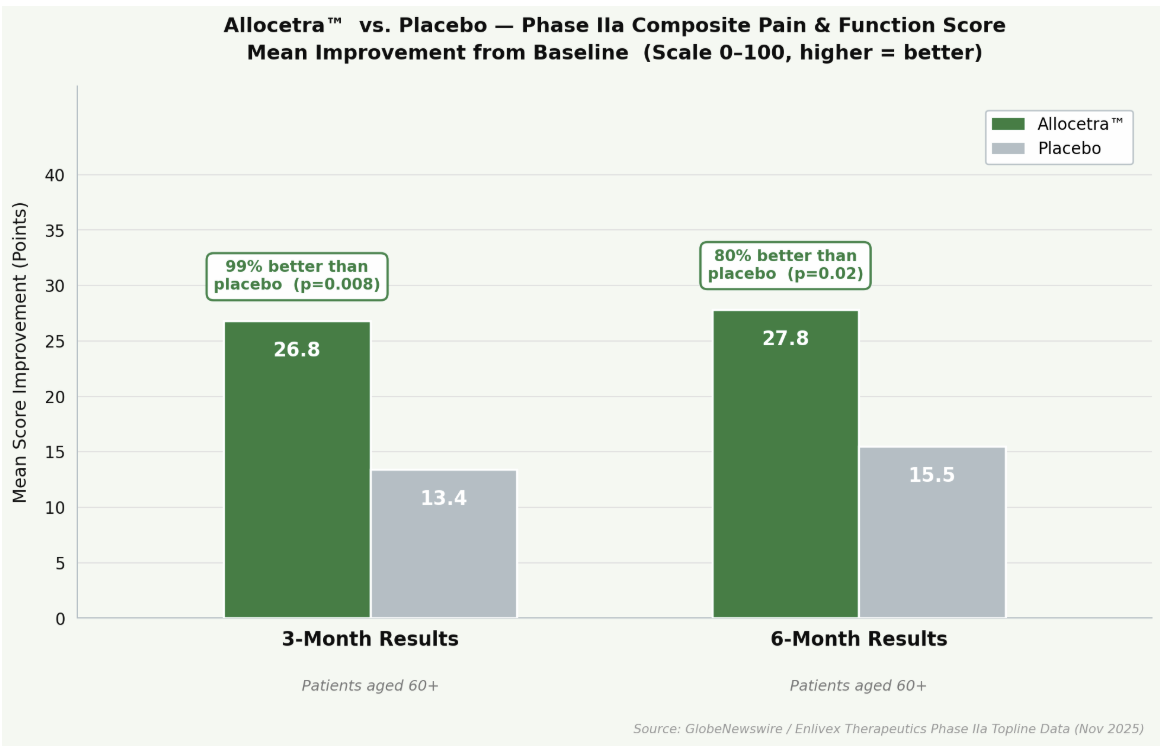
In the randomized, double-blind, placebo-controlled trial across multiple countries, Allocetra delivered an 80% improvement over placebo in composite pain and function scores at six months in patients aged 60 and older (p=0.02).
At three months, that spread was even wider, with a 99% improvement over control (p=0.008).
The durability of that effect, sustained without retreatment for at least six months from a single administration, is the clinical feature that sets this program apart. |




No comments:
Post a Comment