McDonald’s Corporation (NYSE: MCD) found a way to squeeze substantially more profit out of a business that barely grew its revenue in the quarter. Third-quarter sales increased by just $79 million from a year ago, yet operating income climbed by $239 million. Diluted earnings per share reached $3.51, up 10%, while revenue advanced only 1% to $7.16 billion.
Table of Contents
That gap between revenue and earnings growth gives investors a strong profitability story, although the customer numbers introduce a complication. Global comparable sales increased 1.5%, while U.S. comparable sales slipped 0.2%. McDonald’s generated stronger earnings despite struggling to attract more American customers.
Anthropic — the maker of Claude AI — is preparing to go public.
Reports suggest its highly anticipated IPO could happen as soon as November. And its potential valuation could reach into the trillions.
But here's what's really exciting…
Anthropic's rapid growth has investors watching closely for what could become one of the largest technology listings in history. And some investors are exploring ways to gain exposure before the public debut.
McDonald’s operating income rose from $3.36 billion to $3.60 billion, while total operating costs and expenses declined by approximately $160 million. The company also recorded $139 million in net Other operating income, compared with $37 million a year earlier. That $102 million increase accounted for a substantial portion of the operating-income improvement.
Management identified higher Other operating income and stronger sales-driven franchised margins as the primary drivers. Revenue from franchised restaurants increased 3% to $4.49 billion, while sales from company-operated restaurants declined 3% to $2.48 billion. Franchised restaurant margins increased 3%, compared with a 6% decline in company-operated restaurant margins. Total restaurant margins still grew 2%.
The franchise model allows McDonald’s to collect fees and occupancy payments without bearing the full operating expenses of independently operated restaurants. That structure provides an earnings cushion, but the company-operated business reveals where costs are becoming harder to absorb. Management attributed the U.S. company-operated margin decline primarily to ongoing inflationary pressures.
Fewer Customers Are Walking Through The Door
The third-quarter earnings report becomes less reassuring when we examine customer behavior. U.S. comparable sales declined 0.2% because negative guest-count growth was largely offset by positive check growth. Customers who visited spent more, but fewer comparable visits took place.
International operations provided better support. Comparable sales increased 1.4% in International Operated Markets and 4.2% in International Developmental Licensed Markets. Germany and Australia led the operated markets, while Japan helped drive licensed-market growth. China was a partial drag.
Global systemwide sales increased 4% to more than $38 billion, but the U.S. business still needs stronger traffic. Management expects 2026 systemwide sales to grow approximately 2.5% in constant currencies, below the 4% recorded in Q3.
The broader consumer environment makes that recovery harder. Elevated household expenses can make customers more selective about restaurant visits, while higher beef and labor costs pressure restaurant economics. As such, McDonald‘s must offer enough value to attract more visits without allowing discounts and rising expenses to erode margins. Higher average checks cannot indefinitely replace customer traffic.
Expansion Could Carry Growth Beyond Comparable Sales
McDonald’s has another lever if existing restaurants struggle to produce stronger comparable sales. Management expects approximately 2,500 restaurant openings in 2026, including 700 company-operated locations and 1,800 through developmental licensees and affiliates. It expects another 2,100 openings in 2027, targeting 50,000 restaurants worldwide by year-end.
New locations can expand systemwide sales even when comparable sales remain modest. However, expansion requires investment. Management expects capital expenditures of approximately $3.7 billion in 2026 and free cash flow conversion in the low-to-mid 80% range.
Can MCD Turn Its Earnings Strength Into a Sustained Recovery?
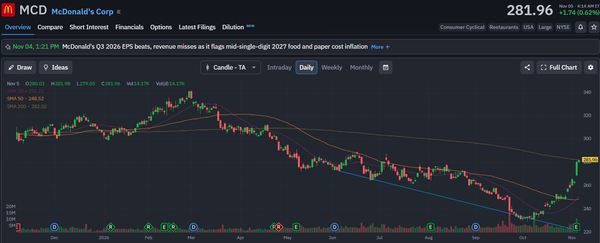
The earnings rally has brought MCD back toward a critical technical level. Shares traded at $281.96 on November 5, above their 20-day moving average of $251.21 and 50-day average of $248.52, but just below the 200-day average at $282.52.
MCD had declined from the low-330s in March toward the low-220s in October. The latest rally has reversed a substantial portion of that decline, but the stock has yet to establish that its longer-term downtrend has ended.
A sustained break above $282.52 would strengthen the recovery. Buyers would then need to defend that level during any pullback. If the breakout fails, the 20-day and 50-day averages around $251 and $249 become the next important support zone.
I’d be cautious about chasing the rally before MCD establishes support above its 200-day average. The franchise model is supporting earnings growth, but higher Other operating income contributed substantially to the latest improvement while U.S. guest counts remain weak.
For investors, the next catalyst is evidence that McDonald’s value initiatives can restore traffic without sacrificing restaurant margins. Until comparable guest counts improve and the stock establishes support above its 200-day average, the earnings beat offers a reason to watch the recovery rather than assume the turnaround is complete.



No comments:
Post a Comment