Any content you receive is for information purposes only. Always conduct your own research. *Disseminated on behalf of First Phosphate Corp
First Phosphate Corp. (NASDAQ: PHOS) Is Topping The
Krypton Street Watchlist This Morning
—Monday, September 21, 2026
Don’t Miss Our Next Update—Get Real-Time Alerts Sent Directly To Your Phone. Up To 10X Faster Than Email. Put (PHOS) On The Radar This Morning…
September 21, 2026 Dear Reader, We’re starting the morning with First Phosphate Corp. (NASDAQ: PHOS) firmly on our radar as several major developments continue to converge around its Québec phosphate project. With sovereign financing support, definitive offtake agreements, and a rapidly expanding LFP battery market all lining up at once, (PHOS) is giving us plenty to watch this morning. There's a question worth asking about the battery revolution that almost nobody seems to be asking… Where does the phosphate come from? First Phosphate Corp. (NASDAQ: PHOS) has an answer — and the G7, Switzerland, Denmark, and Italy are already backing it with sovereign-level financing commitments. But first, consider why that matters… You hear about lithium constantly. You hear about nickel, cobalt, graphite — even manganese gets its moment in the spotlight. But phosphate — the "P" in LFP, the fastest-growing battery chemistry on the planet — barely registers in the conversation. And yet, according to Global Market Insights, the LFP battery sector reached $18.7B in 2024 and is heading toward $90.3B by 2034 at a 16.9% CAGR. The automotive segment makes up 77.6% of that demand today. Energy storage is growing even faster — at a 19.5% CAGR — as grids, data centers, and defense systems all adopt LFP for its thermal stability, long cycle life, and lower cost. That's a staggering amount of demand heading straight at a supply chain that, in North America at least, doesn't really exist yet… Tesla has adopted LFP for the Model 3. BYD's Blade Battery — the chemistry powering the world's best-selling EV brand — is built on LFP. Volkswagen, GM, Stellantis, and Hyundai are all pivoting toward LFP for their next-generation lineups. And none of that cathode material starts with phosphate sourced from North American soil. No domestic mine-to-cathode pathway. No vertically integrated North American phosphate source feeding directly into LFP production. That's exactly the gap First Phosphate Corp. (NASDAQ: PHOS) is building to fill — a complete supply chain from a rare, high-purity igneous phosphate deposit in Québec all the way through to battery-grade cathode material. The company's target end markets tell you where the demand is heading — energy storage, data centers, robotics, mobility, and national security — every segment with its own accelerating pull on LFP adoption. And the speed at which (PHOS) has stacked sovereign financing, G7-level offtake agreements, and government fast-track designations over the past twelve months is something you don't see often at any stage of development… First Phosphate Corp. (NASDAQ: PHOS) is topping our watchlist this morning—September 21, 2026. 
But it’s important to note, (NASDAQ: PHOS) has less than 16M shares listed as available to the public. When companies have small floats like this, the potential exists for big moves if demand begins to shift. And, Mark Reichman, an analyst at Noble Capital Markets, Inc, has a $25.50 target on (PHOS), which suggests The Numbers Behind the Noise
Start with the resource itself, because this is where the foundation of the entire story sits… The company's Bégin-Lamarche deposit — located in Saguenay–Lac-Saint-Jean, Québec — is igneous, not sedimentary. That matters because sedimentary phosphate tends to carry high levels of cadmium, uranium, and other contaminants that complicate purification to battery-grade specifications. Igneous phosphate forms differently — crystallizing from molten rock — and the result is a naturally purer feedstock that requires less processing to reach the quality thresholds LFP cathode manufacturers need. 
First Phosphate Corp. (NASDAQ: PHOS) has confirmed an apatite concentrate grade of 40.4% P2O5 at an 88% process recovery rate, with a battery-grade phosphoric acid conversion ratio of 91.1%. And the deposit has grown dramatically since initial estimates. An updated NI 43-101 Technical Report filed in August 2026 revealed a 378% expansion in indicated mineral resources compared to September 2024. Here's the breakdown: Measured pit-constrained resources: 6.2 Mt at 7.70% P2O5. Indicated pit-constrained resources: 198.5 Mt at 6.00% P2O5. Inferred pit-constrained resources: 89.5 Mt at 6.16% P2O5. The deposit remains open at depth — so there may be more to find. The site sits 50 km from the City of Saguenay, next to hydroelectric infrastructure, and only 70 km from the deep-sea Port of Saguenay. For a critical minerals project of this scale, that kind of proximity to power, roads, and deep-water shipping is exceptional — and it's a big part of what has attracted sovereign-level attention to (PHOS) so quickly. Apatite is listed on the critical minerals registries of Québec, Canada, the United States, and the European Union — a designation that unlocks access to export credit financing, accelerated permitting, and government-backed support programs… Governments Are Clearing the Path
If the resource data tells you what the company has in the ground, the government engagement tells you how seriously the people in charge are taking it… In July 2026, Québec's Ministry of Natural Resources granted (PHOS) "Filon" fast-track status — a permitting acceleration designation created under the province's Critical Minerals Strategy 2025–2031. 
The Québec Minister of Natural Resources described the project as one that transforms the province's geological potential into a genuine economic advantage for future battery markets. The federal government has been moving just as decisively. Natural Resources Canada deployed $4.84M in non-repayable contributions for road infrastructure and a 161-kV power transmission line serving the Bégin-Lamarche site — on top of $16.7M already committed through the Global Partnerships Initiative. Canada's Energy Minister Tim Hodgson stated that these are the kinds of efforts that connect critical mineral projects to the infrastructure they need, create Canadian jobs, and deliver lasting regional prosperity… That adds up to more than $21M in non-repayable federal contributions earmarked for a single deposit. And this isn't happening in isolation. At the 52nd G7 Summit in Évian, France, the company formalized offtake and financing agreements under the Critical Minerals Resilience and Production Alliance — an initiative bringing G7 nations together to de-risk and accelerate critical mineral projects. 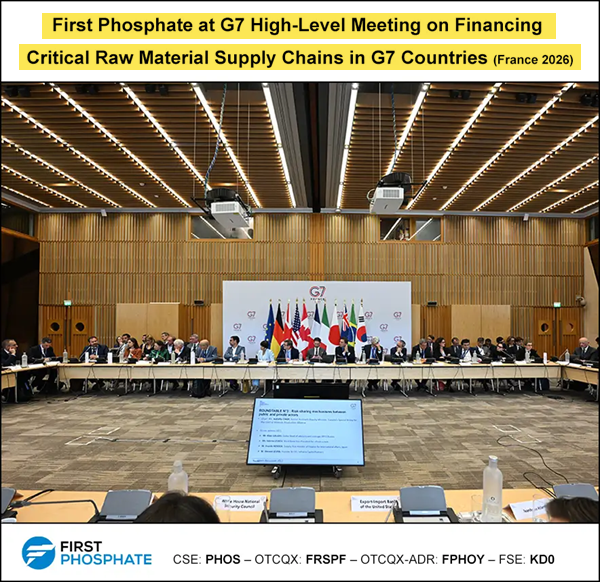
The offtake agreements alone are worth noting: a definitive deal for a minimum of 200,000 tonnes per annum of phosphate concentrate, and a separate definitive deal for 60,000 tonnes per annum of phosphoric acid. That's committed demand from creditworthy partners, not speculative interest. Definitive agreements, signed and formalized under a G7 framework — the kind of offtake visibility that materially de-risks a development-stage critical minerals project… Following the Financing Trail
The sovereign financing commitments layered around this project read like a who's who of allied-nation export credit agencies… SERV — Switzerland's export credit agency — delivered a Letter of Support in September 2026 for approximately USD $212.5M, covering Swiss equipment, machinery, and construction services for the mine and processing facility. SERV indicated willingness to cover up to 95% of the eligible financed amount, with the total potentially increasing if the Swiss export contract value rises. EIFO — Denmark's AAA-rated state-backed export credit agency — extended an LOI for up to CDN $275M to support mine development. And Italian agencies SACE, CDP, and SIMEST provided LOIs supporting the phosphoric acid plant planned for Port Saguenay — adding another layer of sovereign-backed financing and downstream processing support to the buildout. When you step back and look at the full picture — Swiss financing, Danish financing, Italian technology partnerships, Canadian federal infrastructure funding, Québec permitting acceleration, and G7-endorsed offtake — this is a project that allied governments are treating as strategically significant. That alignment across multiple sovereign entities doesn't happen by accident. It happens when a resource sits at the intersection of scarcity, purity, and geopolitical urgency — and when the path from deposit to end product is clear enough for export credit agencies to put real numbers behind it. (PHOS) completed its Nasdaq Global Market uplisting effective August 10, 2026, bringing its ADR onto a major U.S. exchange under the ticker PHOS at a point where these potential catalysts are accumulating quickly. The company's target markets span energy storage, data centers, robotics, mobility, and national security — every sector pulling LFP demand higher as the decade unfolds. CEO John Passalacqua captured the broader significance at the G7, noting that the company is proud to lead the development of this clean, rare igneous phosphate from Québec into a downstream LFP battery supply chain serving the entire G7 alliance… 9 Reasons We Have (PHOS) On Our Radar This Morning —Monday, September 21, 2026…
1. Analyst Coverage: Noble Capital Markets analyst Mark Reichman has placed a $25.50 target on PHOS, adding third-party research coverage as the company advances its Québec project. 2. Tight Float: With fewer than 16M shares listed as available to the public, PHOS has a relatively small float that could have the potential for big moves if demand begins to change. 3. Resource Expansion: An August 2026 NI 43-101 update showed a 378% increase in indicated mineral resources at the Bégin-Lamarche project controlled by PHOS. 4. High Purity: Metallurgical work at PHOS reported 40.4% P2O5 apatite concentrate, 88% process recovery, and a 91.1% battery-grade phosphoric acid conversion ratio. 5. Federal Support: More than $21M in non-repayable Canadian federal contributions has been directed toward infrastructure supporting the Bégin-Lamarche project being advanced by PHOS. 6. Fast Track: Québec granted the project operated by PHOS “Filon” fast-track status under the province’s Critical Minerals Strategy 2025–2031. 7. Major Offtakes: Definitive agreements tied to PHOS cover at least 200,000 tonnes annually of phosphate concentrate and another 60,000 tonnes annually of phosphoric acid. 8. Financing Support: Switzerland’s SERV and Denmark’s EIFO have provided financing support documents tied to PHOS, including approximately US$212.5M from SERV and up to CDN$275M from EIFO. 9. Growing Market: With the LFP battery sector projected to expand from $18.7B in 2024 to $90.3B by 2034, PHOS is developing phosphate supply aimed at energy storage, data centers, robotics, mobility, and national security. Put (PHOS) On The Radar This Morning…
The LFP battery revolution runs on phosphate… And right now, North America is building its first homegrown supply chain to deliver it — from a rare igneous deposit in Québec, backed by the G7, financed by three allied nations, and fast-tracked by the Canadian and Québec governments. First Phosphate Corp. (NASDAQ: PHOS) sits at the center of that effort. Add (PHOS) to the radar this morning while it’s still early. Sincerely, Alex Ramsay Co-Founder / Managing Editor Krypton Street Newsletter |


No comments:
Post a Comment